
 Hafi einhver haldið að sjókvíaeldi á laxi gæti ekki orðið ógeðslegra eru hér glænýjar fréttir fyrir viðkomandi.
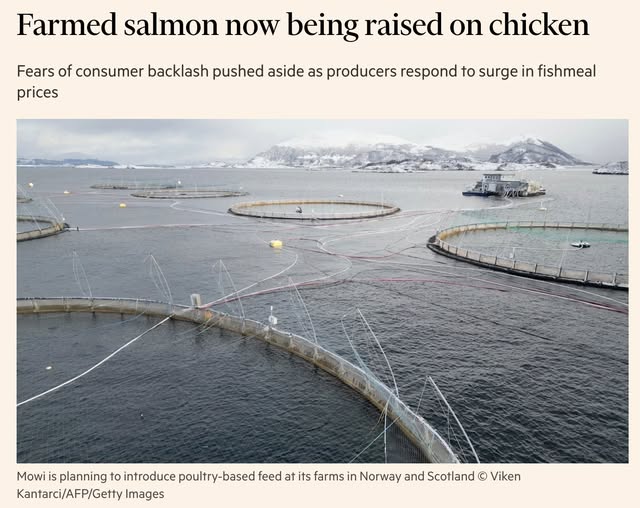
Norsku sjókvíaeldisfyrirtækin, þar á meðal móðurfélög Arnarlax og Arctic Fish á Vestfjörðum, eru farin að ala eldislaxana á fóðri gert úr kjúklingi. Þetta kemur fram í frétt sem birtist í Financial Times í morgun.
Já, þið lásuð rétt. Eldislaxarnir í sjókvíunum er nú fóðraðir með afurðum úr hrikalegasta verksmiðjubúskap sem mannkyn hefur fundið upp.
Ástæðan fyrir þessu er skortur á próteinum úr villtum fiski og gríðarleg hækkun á verði á fiskolíu og mjöli. Algjör aflabrestur er á ansjósuveiðum við Perú, en undanfarin 60 ár hafa þær veiðar einar staðið undir um það bil 10 prósent af öllum sjávarafla úr höfum heimsins.
Eldislax er ofarlega í fæðukeðjunni (er rándýr og próteinæta) og margfalt meira þarf af næringarefnum til framleiðslunnar en hún gefur af sér.
Fyrir hvert kíló af próteini sem sett er í fóður fyrir eldislax sitja í besta falli um 250 grömm eftir í þeim hluta fisksins sem fer til manneldis. Um 75 prósent af próteininu tapast í efnaskiptum fisksins, orkunotkun hans (fer í umhverfið sem saur), eða endar í sláturúrgangi.
Fóðurnýting laxeldis og rækjueldis er sú langversta í lagareldi á heimsvísu.
Talsmenn iðnaðarins reyna gjarnan að villa um fyrir fólki meða því að að bera saman þurrvigt á fóðri (dry weight) við blautvigt á heilum slátruðum fiski (wet weight), sem á síðan eftir að flaka.
Ef aðeins er horft til þess próteins sem skilar sér í æta hluta eldislaxins (flakið) verður hlutfallið enn lægra, eða nær 18 til 25 prósentum.
Eldislax er um 4 til 5 prósent af lagareldi heimsins en notar margfalt það hlutfall af fóðri miðað við aðrar tegundir en rækju.
Í frétt Financial Times kemur fram að skoðanakönnun á vegum matvælarannsóknastofnunarinnar Nofima á þessu ári sýnir að neytendum í Bretlandi og Frakklandi þykir það „ónáttúrulegt og ógeðslegt“ að fóðra eldislax á kjúklingi.
Hér er áhugaverð umfjöllun The Guardian um stöðvun veiða við Perú:
Peru’s anchoveta have made up about a 10th of the entire global commercial fishing catch since 1970, more than any other fish. A combination of warming seas and decades-long overfishing spells disaster
On 10 June 2026, the government of Peru made a decision that it knew would hurt one of the world’s major fishing industries. It stopped all anchoveta fishing boats from going out to sea, suspending the fishing season. At first the order was temporary, but in mid-August, the suspension turned into a total closure. …
Peruvian anchovies – the scientific name is Engraulis ringens – are not the salty, punch-packing little fillets in a puttanesca sauce or caesar salad dressing. That is a different species – Engraulis encrasicolus – which is smaller, tastier and found mostly in the eastern Atlantic and the Mediterranean. Only a small part of Peru’s anchoveta catch is eaten in fish form. The rest – more than 90% – is immediately processed as fishmeal and fish oil, packed in sacks and barrels, and shipped to fish, shellfish and seaweed farms, factory farms and nutritional supplement producers around the world.
… By weight, Peruvian anchoveta have made up about a 10th of the entire global commercial fishing catch since 1970, more than any other fish. Some years, the anchoveta catch is worth close to $3bn and directly employs almost 50,000 people, close to a quarter of a million if you include indirect jobs. The Peruvian central bank is forecasting a 30.7% contraction for the fishing sector and about 78,000 job losses in 2026, and another 44,000 in 2027.
The ripples will be felt far beyond Peru’s borders. The country is by a long way the world’s most important exporter of fishmeal – a crucial input to aquaculture and livestock agriculture virtually everywhere – and prices are skyrocketing as a result. This anchoveta closure will have a direct impact on jobs, food supplies and supermarket prices the world over. Peru’s then minister of production, César Quispe Luján, defended the decision as the only one possible: “The government has the responsibility to manage marine resources based on scientific criteria, timeliness and a long-term vision. When there is a need to strengthen conservation measures, it is necessary to act with prudence and responsibility to ensure the sustainability of the fishery.”
…In an average year, Peru produces 20% of the world’s fishmeal. But that word “average” obscures the extraordinary volatility of the anchoveta catch in the decades since the fishery was fully commercialised after the second world war. In 1970, Peru landed more than 12m tonnes of anchoveta. In 1973, the catch fell by 88%. The shock of this stock collapse was so existential for Peru that the military dictatorship introduced the first regulatory regime for the anchoveta fishery. In 1984, the catch plummeted again, to less than 100,000 tonnes, a fraction of what it had been 15 years earlier. The catch recovered in 2000 to about 9.6m tonnes, but has declined since then. Recent annual catches have been in the 2m-4m tonne range.
Overfishing has played a crucial role in this ecological and economic rollercoaster ride. But the crazy seesaw of the anchoveta fishery is not merely a tale of rapacious industrial extraction, but of how overfishing combines with the bouts of accelerated oceanic warming driven by El Niño, which always hit Peruvian coastal waters especially hard.
El Niño (“the little boy”) is the name that fishermen four centuries ago gave periods of unusually warm water off the coast of western South America. It is so named because the episodes usually reach their peak towards Christmas.
…
In its latest report on the state of the world’s marine fisheries in 2025, the UN Food and Agriculture Organization deemed more than a third to be overfished, meaning harvests exceed the rate of reproduction. Though the report classifies most of the anchoveta stocks in Peru as “maximally sustainably fished”, it is worth remembering that calling a fishery sustainable does not take account of the fact that populations are at historically low levels – and, since the onset of industrial fishing, are more vulnerable than ever before.
…A further cause for alarm, and not just for commercial fisheries, is that in the web of predatory relationships, anchoveta are a crucial link between plankton and larger animals: the anchoveta feed on plankton, their population flourishes, which provides food for scores of predator species higher up the food chain, including humans. When anchoveta numbers plummet, it is a potential catastrophe for the whole ecosystem and those who depend on it. When this happened to the Black Sea anchovy late in the 20th century, phytoplankton populations exploded, depleting oxygen levels in the water and threatening an already fragile marine ecosystem, and the other commercial fisheries that depended on it.
The anchoveta matter in all these economic and ecological ways, but they also epitomise a widespread problem in our extractive age: in ecosystems around the world, we are pushing species into conditions of such fragility that we are no longer in control of the situation. Even if we slow or even stop destroying habitat or harvesting, things are now so precarious that “natural” environmental variability could tip them over the edge.
Anchoveta have proven resilient in the face of remarkable levels of environmental variation, from extreme El Niño events to the frenzied overfishing of decades past, but the prognosis isn’t good: research suggests that ocean warming and its effects will lead to a decrease in the amount of anchoveta in the ocean of between 8% and 14% per decade across the 21st century. As sea surface temperatures rise, and salinity and oxygen levels change, the anchoveta’s territorial range shifts, as does the stock’s fertility, spawning seasons and the distribution of the population across different life stages (a crucial consideration in fisheries, because it is imperative to avoid catching fish that are too young to reproduce). All of this is unfolding against the background of ongoing climate heating at a planetary scale, to which El Niño introduces additional and increasing stresses.
…
If all these efforts work out as planned, then when a fishery hits the quota in a fishing season, it means (at least in theory) that the industry is accurately reporting their operations, the stock assessment was more or less correct, and the regulators and inspectors are doing their jobs. The alternative – a quota that is never reached – might at first glance seem better, but would be very bad news if the whole fleet was out there and couldn’t find enough fish to meet the allowance. This has happened before, most famously during what fisheries expert Dean Bavington calls the “managed annihilation” of Atlantic cod. For centuries, cod had made Newfoundland’s Grand Banks one of the planet’s most productive fisheries. By the time the fishery collapsed completely in the early 1990s, the absurdly high quota didn’t matter because the boats couldn’t find anywhere near enough fish to meet it. The oceans had been emptied; the cod were gone.
In contrast to Newfoundland, Peru’s fisheries managers decided to protect the anchoveta population, despite pressure from an industry that has a lot of sway with the government and is increasingly concentrated in the hands of massive corporations, foreign and domestic. (In November 2024, the Canadian conglomerate Cooke Incorporated paid $1bn for Copeinca, the largest anchoveta firm in Peru. Cooke now controls a sixth of Peru’s anchoveta fishery, and a fifth of its meal and oil processing.) Corporate power like that doesn’t take massive revenue losses lying down. When the government delayed the start of the fishing season in 2023, the CEO of an anchoveta conglomerate moaned that regulators were “lost in a sea of ignorance”, creating an existential crisis for an industry that was “fighting to survive”. At that point, the ministry budged a little, and temporarily reopened the fishery. This year, it held firm: “Sustainability takes precedence over any short-term decision,” Juan Carlos Requejo, the minister of production, said in mid-August.
The stakes are enormous. Peru’s fisheries sector contracted by almost 75% in June and July, and fishmeal production is plummeting just as prices have skyrocketed to almost $3,500 a tonne, more than twice what they were at the same time last year. The same is true of all the fisheries for high-value species that prey on anchoveta: the bonito, jack mackerel and the rest of the bigger torpedo-shaped beauties that bring in premium prices.
The privatisation of the Peruvian anchoveta fishery began in 1992 and culminated in the introduction of a vessel quota system under the guidance of the World Bank in 2009. The creation of private property rights in the fishery has had complex repercussions, not least the increasing marginalisation and impoverishment of tens of thousands of smaller-scale fishers and their communities. Almost all the anchoveta catch is controlled by a collection of wealthy boat owners and big firms with close ties to the state.
…